
STILL MADE HERE (reprinted from trendwatching.com)
Last month, Trendwatching discussed
TRANSPARENCY TYRANNY. The month before that, it was all about
CROWD CLOUT. Two trends firmly rooted in the online revolution, offering further proof that the most disruptive innovations are now to be found online.
However, that’s not to say the bricks-and-mortar world has become an innovation backwater. Two mega-trends of our time, the greening of consumption and the proliferation of alternative status symbols, hold the promise of vast new riches for real-world entrepreneurs, while wreaking havoc on those that lag behind. Which brings us to the (STILL) MADE HERE trend: the comeback of all things local, all things with a sense of place, and how they're surfacing in a world dominated by globalization.
“(STILL) MADE HERE encompasses new and enduring manufacturers and purveyors of the local. In a world that is seemingly ruled by globalization, mass production and ‘cheapest of the cheapest’, a growing number of consumers are seeking out the local, and thereby the authentic, the storied, the eco-friendly and the obscure.”In this briefing, they (trendwatching) focus on three big drivers behind this trend — social responsibility, status and support. There are more, but we'll save those for a future update. Oh, and don’t worry, we’re not going to wax on for hours and hours about farmers' markets ;-)
Now, let’s start with everyone's favorite 800-pound gorilla: social responsibility, from eco to ethics.
Eco and ethics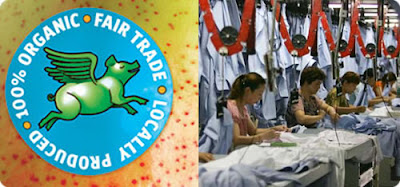 Global vs. local
THE story of 2006, 2007, 2008 and many years to come? Consumers, governments and business leaders are finally feeling the pressure to confront and act upon the fact that unbridled production and consumption comes with mounting pollution and at a significant human/animal/earth cost. Now, since virtually every think tank, trend firm, eco-blog, former US presidential candidate and oil company has chimed in on the issue, we'll refrain from rehashing endless studies and scenarios on the globe's future. Instead, we'll focus on one sub-trend — locality — that is still emerging and as such can offer brands additional inspiration to come up with new goods, services and experiences that are part of the solution, not the problem.
Let's start with 'eco'. Now that carbon footprinting has become a household term in mature consumer societies, expect consumers' desire to find out about the origins of a product to become a given. Questions no one ever asked a few years ago will become an integral part of the purchasing process. How was the product made? By whom? How did it get to its point of sale? What effects on the environment will it have after purchasing?
Increasingly, this transparency will pit distant production against local production. Above all, local production holds the promise of less pollution due to less transport. And, in prosperous and regulated nations, chances of inhumane labor practices are smaller, too.
A slew of projects and publications are fanning the current debate on local versus global production. Not too surprising, it’s the food and beverage sector — which can be both closest to, and most removed from nature — that finds itself at the forefront of the eco-meets-local debate, while the apparel industry (sweatshop, anyone?) is feeling the impact of ethics-meets-local more than any other industry.
To stick with our promise to not repeat too much that others have already effectively investigated, we'll gladly refer you to the books and projects below: they all deal with the specifics of how local consumption may (or may not!) trump more wasteful global activities.
 Life story labels
Now, to stick to our usual approach, let's look at some brands that are already experimenting with attaching ‘life story labels' to their products, satisfying consumers who are ready to spend their dollars, euros, pounds and yens on whatever does the least harm:

UK supermarket
Tesco plans to introduce carbon footprint labels on all 70,000 products it sells to allow shoppers to compare carbon impacts. Implementation will take a while: the company is currently investigating how to develop a “universally accepted and commonly understood” measuring system.

Last year, footwear manufacturer
Timberland started placing a "nutritional label" on each shoe box, educating consumers about the product they are purchasing, including where it was manufactured, how it was produced and what effect it has on the environment. Nice touch: messaging inside the box asks customers "what kind of footprint will you leave?" and provides a call to action for them after purchase. Hey, it takes two to tango!

Dole Organic lets consumers “travel to the origin of each organic product”. By typing in a fruit sticker's three-digit Farm Code on
Dole Organic's website, customers can read background info, view photos of the farm and workers and learn more about the origin of Dole products.

What works for bananas, works for eggs. Aptly naming their site
wheresyoursfrom, UK-based Chippindale Foods was the first company to offer customers full egg traceability. Also check out intermediary
MyFreshEgg, which aims to be bringing the same services to a host of farms and egg producers.

And the examples keep rolling in: from Nature and More to Lloyd Maunder West Country to Aceites Borges Olive Oil.
The latter gives each bottle of olive oil a Numero de Lote (batch number), informing customers about the geographic origin of the olives, the pressing date, oil producer, place of pressing, liters bottled under the same batch number, date of bottling, degree of acidity, tasting score and tasting notes.

Next for these 'life story' labels? Integration with ‘supply-chain’ codes like barcodes, QR codes and RFID, of course. Which will really take flight when, as is already the case in Japan, millions of consumers have code reading software on their camera-phones. Which means that infinite amounts of information (including images and videos) can be 'attached' to products, satisfying even the most seriously
INFOLUSTY consumers. To be continued, though probably not a bad idea to start mapping out your product life stories strategy as soon as possible?
Taking back productionNow, books and labels are fun, but how about setting up entirely new (STILL) MADE HERE ventures? Expect local companies to take back production that's currently based in regions less concerned with eco and ethics. Some examples:
 American Apparel
 The most famous advocate of (STILL) MADE HERE deals with ethical concerns in a radical way: by manufacturing its garments in… high-cost LA. American Apparel now operates the country's largest garment factory, employs more than 5,000 people and operates 145 retail locations in 11 countries. Workers are paid (on average) USD 12 an hour, almost twice as much as California's minimum wage.

American Apparel isn't the only brand to do so:
NoSweatApparel calls itself the pioneer of fair trade fashion and footwear, setting (in their own words) an empowered, unionized workforce as the gold standard for fair trade clothing.

And for those of you needing more proof that (STILL) MADE HERE can be profitable and sexy:
Ujena offers one of the largest selections of swimwear in the world, yet still manufactures its products in the United States.

Back to edibles: Dutch start-up Happy Shrimp is Europe’s first tropical shrimp farm, located in the very non-tropical port of Rotterdam. Promising fresh (‘superfresh’) shrimp, aimed at local restaurants, the business is taking on low cost shrimp farming in Asia. It does so by smartly capitalizing on trends that the competition may find hard to latch on to.
First of all,
Happy Shrimp is thoroughly eco-friendly. Its farm is located next to a power plant and benefits from a heat-exchange system, using waste heat that would otherwise be released into the air. Farm waste, meanwhile, is used in a biological filter bed (many existing shrimp farms in the southern hemisphere pollute coastal wetlands).
Secondly, Happy Shrimp promises demanding consumers that the food on their plate is safe and unpolluted. An ISO 22,000 system is implemented throughout the whole process, while the farm is a closed recirculation system, which means nothing can enter or exit.
Thirdly, as the current trend in food and beverage is all about freshness, with supermarkets increasingly shifting from packed and canned goods to fresh, if not produced on the premises offerings (STILL MADE HERE indeed!), Happy Shrimps prides itself on being able to deliver shrimp to local restaurants within hours after ‘harvesting’, without freezing or month-long travels on mega-freighters. To feast on Happy Shrimp, locals will have to wait until the end of this year: the first baby shrimps arrived at the farm early May, and they’ll be ready for consumption this Christmas.

To completely eliminate transit between source and table — and the need for egg traceability labels — British
Omlet brings hens to consumers' gardens and fresh eggs to their table every morning. The company designed a hen kit for urban and suburban gardens, aimed at first-time chicken owners, families and eco-savvy individuals. How it works? Omlet supplies organically reared and fully vaccinated female chickens (no early morning cock-a-doodle-doo), at a cost of GBP 365 (USD 700 / EUR 550). The two-hen service comes complete with an Eglu, an eye-catching, 21st century version of the henhouse. In its first three years of business, the company sold 10,500 Eglus and is now also offering a larger version, the Eglu Cube, capable of housing up to 10 chickens.
Read the rest of this interesting article
here .


